



Enterprise Risk Management
Manage Uncertainty with a Strategic Approach
Today’s business environment is evolving faster than ever with risks emerging from every direction. Without a clear risk strategy, organizations can find themselves reacting to crises with no clear plan in place to effectively manage through the event.
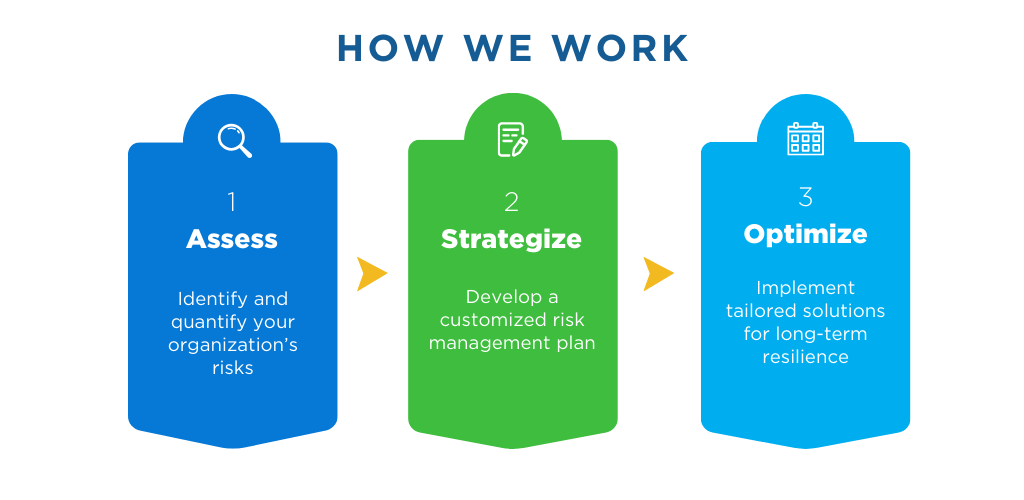
HUB Enterprise Risk Management (ERM) solutions offer an integrative, data-driven approach to identifying, assessing and managing risk across your entire organization. Our experts work with you to develop customized strategies that mitigate vulnerabilities, strengthen resilience and position your business for long-term success.
Why Choose HUB?
Organizations often operate in silos, leaving critical gaps in the protection that a mature risk management program supports. HUB ERM integrates all aspects of risk—financial, operational, compliance, governance and strategic—into one cohesive risk framework, ensuring nothing falls through the gaps.
HUB’s ERM experts develop customized, actionable strategies based on deep industry expertise and data-driven insights to ensure that your risk management plan is aligned with your specific objectives.
Our risk quantification models help you prioritize risks based on financial exposure, probability and strategic impact. This facilitates smarter decision-making for risk financing, insurance solutions and resource allocation.
HUB ERM takes a proactive approach, identifying vulnerabilities and implementing mitigation strategies before they escalate. Our clients gain peace of mind knowing they have a clear roadmap to navigate emerging threats.
Turn Risk into a Competitive Advantage
Organizations that integrate risk management into their corporate culture don’t just survive disruptions—they turn them into growth opportunities. With a well-structured ERM program, you can improve stakeholder confidence, enhance operational stability and lower your Total Cost of Risk by demonstrating a commitment to sustainable resilience.
What risks does ERM cover?
Organizations that integrate risk management into their corporate culture don’t just survive disruptions—they turn them into growth opportunities. With a well-structured ERM program, you can improve stakeholder confidence, enhance operational stability and lower your Total Cost of Risk by demonstrating a commitment to sustainable resilience.
- Strategic — Competitive threats, market disruption, technology obsolescence and failed innovation initiatives that undermine long-term positioning.
- Operational — Supply chain failures, equipment breakdowns, workforce disruptions, process failures and quality control issues that halt day-to-day operations.
- Financial — Market volatility, credit exposure, liquidity constraints, foreign exchange fluctuations and interest rate changes affecting profitability.
- Regulatory and compliance — Evolving legal requirements across jurisdictions for data privacy, environmental standards, employment practices and industry-specific regulations.
- Cybersecurity — Data breaches, ransomware attacks, system outages and third-party vendor vulnerabilities threatening operations, finances and reputation.
- Reputational — Brand damage from incidents, executive misconduct, product failures, environmental disasters or social media crises that erode stakeholder confidence.
ERM governance: Who owns risk?
Effective ERM requires clear ownership across the organization — not siloed in a single department. Boards set risk appetite and provide strategic oversight. C-suite leaders champion risk culture and resource allocation. Chief Risk Officers manage assessment and reporting. And operational leaders identify and mitigate risk within their business units.
Distributing accountability this way embeds risk management into daily operations.
Our Capabilities
- Comprehensive Enterprise Risk Assessment
- Risk Appetite & Tolerance Evaluation
- Enterprise Risk Quantification
- ERM Framework Development
- Risk Mitigation & Resilience Planning
- Compliance and Governance Strategies
- ERM Program Review & Maturity Assessment
Partner with HUB ERM Today
Protect your business, safeguard your reputation and build long-term resilience with HUB Enterprise Risk Management. Whether you’re looking to enhance your current risk management strategy or build a program from the ground up, our experts are ready to help.
Get in touch today with a HUB ERM specialist to learn how we can support your organization.
Enterprise Risk Management FAQ
Enterprise risk management is an integrated framework that identifies, assesses and manages risks across all organizational functions through a unified strategy. Unlike traditional risk management where finance, operations and compliance each address their own exposures independently, ERM treats risks as interconnected and requiring coordinated responses.
The difference becomes clear when something goes wrong. A supply chain disruption handled in isolation can quietly escalate into a financial crisis, then a reputational issue, then a strategic threat. ERM establishes enterprise-wide visibility that prevents that kind of cascading failure, and organizations with mature programs consistently recover faster and maintain stronger stakeholder confidence.
At scale, risk doesn't just grow, it multiplies. A manufacturing disruption ripples across global supply chains. A cybersecurity breach triggers notification requirements across multiple jurisdictions. The interdependencies that make large organizations powerful also make siloed risk management dangerously inadequate.
ERM gives organizations the visibility to understand their true Total Cost of Risk, including uninsured exposures and business interruption impacts that never appear in traditional analyses. Yet, according to HUB International's 2026 North American Outlook Report, only 5% of North American organizations demonstrate advanced risk maturity. This gap represents a significant competitive vulnerability for any sized entity. For growing organizations, establishing risk strategies early on is critical to setting the stage for successful ERM and business longevity. For already complex organizations, ongoing monitoring and level checks are necessary to ensure risk strategies continue to match the scale and breadth of operations.
ERM programs address six major risk categories: strategic, operational, financial, regulatory and compliance, cybersecurity and reputational. What distinguishes ERM from narrower approaches is the focus on how these categories interact. A cyber incident can simultaneously create compliance obligations, legal liability and operational disruption that no single team is equipped to handle alone.
Operational exposures tend to be the most immediate, while reputational risk is often the most underestimated. Unlike most other categories, reputational damage is largely uninsurable, and social media can accelerate its impact faster than organizations can respond without a coordinated plan already in place. ERM programs analyze how these risks interact, ensuring organizations prepare for compound scenarios where multiple exposures materialize simultaneously.
Enterprise risk management supports strategic decision-making by providing risk-adjusted financial analysis that reveals cost and vulnerability implications before commitments are made. ERM builds organizational resilience by stress-testing business continuity plans against multiple disruption scenarios, ensuring critical operations can withstand compound crises.
ERM frameworks analyze regulatory requirements, political stability, supply chain reliability and reputational considerations alongside financial projections when evaluating market entry. M&A due diligence incorporates comprehensive risk assessment of target companies. Organizations with mature ERM programs conduct scenario planning testing responses to pandemic-like disruptions, catastrophic weather events and cyber incidents.
Risk identification works best when it draws on multiple vantage points simultaneously: cross-functional workshops, internal data from claims and audits, external threat intelligence and scenario planning for compound events. The goal is to surface risks that no single team would catch on its own.
Assessment then converts that inventory into prioritized action. Qualitative scales work for many exposures but more complex financial risks benefit from quantitative tools like HUB's FirstRate™, which stress tests how retained losses would affect key financial strength metrics and ensures resources flow toward the risks that genuinely threaten business continuity.
ERM serves as the connective tissue between functions that often operate independently. Boards rely on ERM programs for the enterprise-wide risk visibility their oversight responsibilities require. Compliance teams use ERM frameworks to consolidate regulatory obligations across jurisdictions. Cybersecurity teams benefit from having technical controls positioned within broader business continuity planning rather than treated as a standalone IT concern.
A data breach illustrates why integration matters: it simultaneously triggers notification obligations, creates legal liability and threatens operational continuity. Without ERM connecting those threads, organizations end up with fragmented responses that slow recovery and amplify damage.
Enterprise risk management requires genuine commitment at every level, not just a dedicated risk function. Boards and senior leadership set the tone by defining risk appetite and demonstrating that risk management is a strategic priority, not a compliance exercise. Risk professionals coordinate assessment processes and reporting and business unit leaders own the actual work: identifying risks in their areas, implementing mitigation strategies and monitoring the indicators that signal emerging problems.
That last group is what makes ERM functional rather than theoretical. When risk consideration is embedded into how operational leaders make everyday decisions, the framework works.